


Beyond the Robot is Back

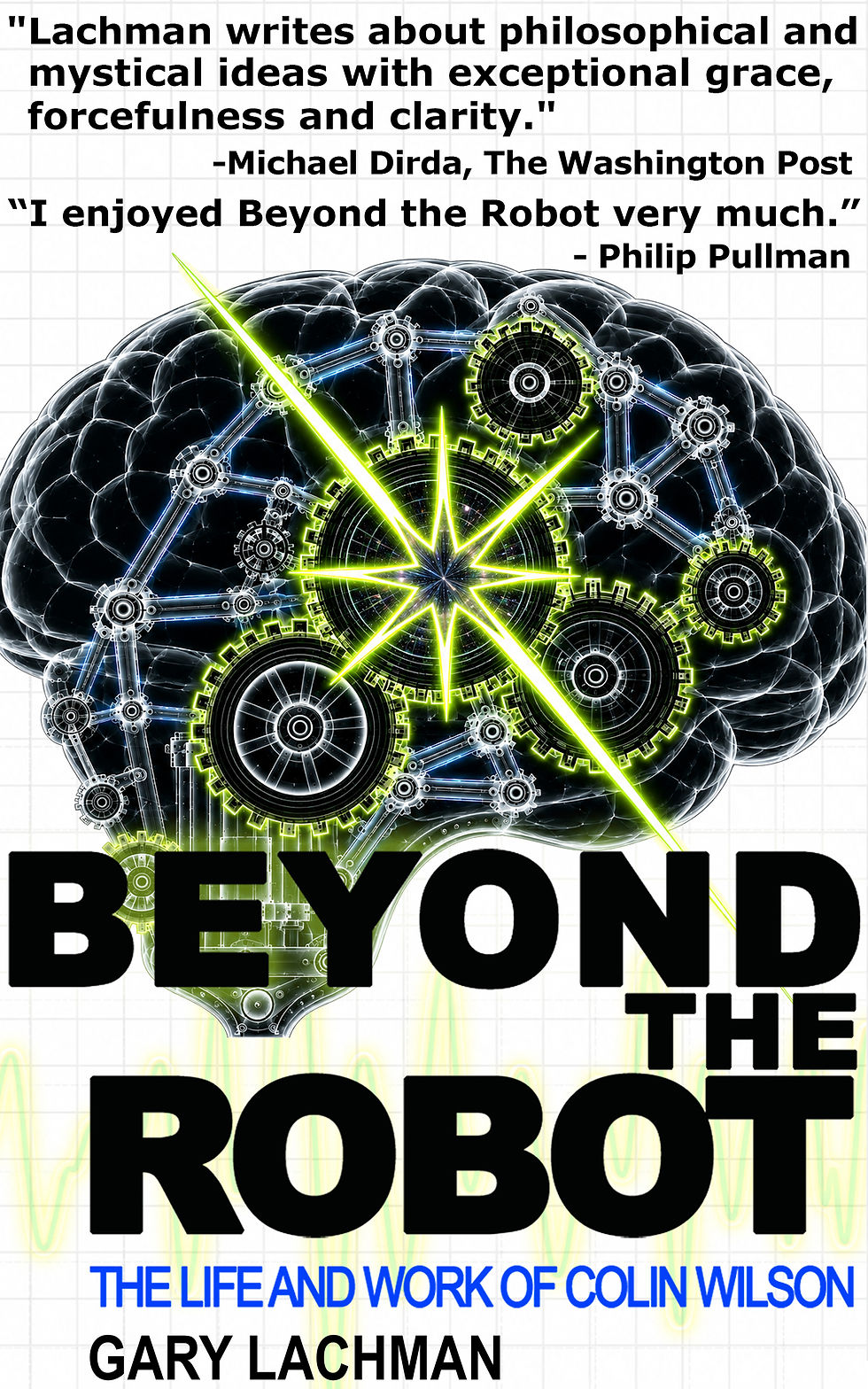
Beyond the Robot: The Life and Work of Colin Wilson, long out of print and obtainable only at inflated prices, is once again available. Having spent the summer learning how to format for e-publication, I am chuffed (perhaps my favourite bit of Britspeak) to be able to share the fruits of my labour. The e-book edition includes the original text to the 2016 Tarcher/Penguin paperback, plus an Afterword, "Beyond the Robot: Ten Years On," bringing things up to date. It also sports a catchy cover design, courtesy of my very good friend, Lisa Jane Persky. One thing I reflect on in the Afterword is Wilson's intuitive, phenomenological insights into the workings of our twin cerebral hemispheres, which in many ways anticipate the more detailed findings of Iain McGilchrist, in his book The Master and His Emissary. A print-on-demand paperback edition will be available soon, and I'm discussing the possibility of an audio book too.
The following is the Introduction to the book. I post it with the sincere hope that we all, one day, get beyond the robot.
A Pilgrimage to Tetherdown
In the summer of 1983 I found myself travelling to Cornwall, in the far west of England. For the past several years I had been reading the work of a writer whose ideas interested me deeply and I was on my way to meet him. His name was Colin Wilson. Wilson had achieved overnight fame in 1956 at the age of twenty-four with his first book, The Outsider, a study in existentialism, alienation and “extreme mental states.” No one was more astonished than Wilson himself to discover that this work dealing with the angst and spiritual crises of figures such as Nietzsche, Van Gogh, Dostoyevsky, T.E. Lawrence, H. G. Wells and others had become an instant best seller. But surprisingly it had. Reviews were glowing and critics tripped over each other to hail England’s own “home-grown existentialist.” After years of struggle, sacrifice and hard work, Wilson had made it. The Outsider was “in.”
The glory, alas, was short lived. Fame, especially in England, is fickle, and after the initial praise-- “A MAJOR WRITER, AND HE’S ONLY TWENTY-FOUR” the headline of one review ran-- the press and serious critics soon turned on what they were now calling a “messiah of the milk bars.”[i] The tag came from Wilson’s association with a group of writers the press had christened the “Angry Young Men”-- roughly equivalent to America’s Beat Generation-- people like John Osborne, Kingsley Amis, John Braine, and others. Although Wilson had very little in common with them, he was guilty by association, and when the critical tide turned against these angry men, he was caught up in it. In practically no time at all, Wilson went from being a boy genius to persona non grata, a status among the literary establishment that he laboured against for the rest of his career and was never quite able to throw off.
It was after this critical thrashing that Wilson left London and moved to a remote village in Cornwall. Here he hunkered down and over the years developed what he called a “new existentialism,” an “evolutionary,” optimistic philosophy which would eventually include areas of the occult and mysticism. He hoped this would counter the bleak dead end in which he believed the existentialism of Sartre, Camus and Heidegger had found itself, and in which most of modern culture had also become mired.
Wilson’s idea of an optimistic, evolutionary existentialism excited me. I had spent the past several years tracking his books down, reading everything by him that I could find. That was why I found myself at the tail end of a two month sojourn in Europe-- much of it spent visiting “sacred sites”-- making the journey down to Cornwall to meet him.

I had first came across Wilson’s work some years earlier, in 1975, when I was nineteen and living on New York’s Bowery, playing in the band Blondie. I had recently developed an interest in the occult.[ii] Punk was on the rise but remnants of the previous hippie generation could still be found and among the books I read at the time was Wilson’s The Occult, which had been published in 1971 and which briefly re-established his reputation after the critical bashing following The Outsider.
What was exciting about The Occult was that Wilson approached the mystical, magical and paranormal from the perspective of existential philosophy. It was not a book of spells or accounts of haunted houses but an attempt to understand occult phenomena in terms of a philosophy of consciousness that Wilson had been developing for more than a decade and which I later understood was based on the work of the German philosopher Edmund Husserl, whose “phenomenology” became the basis for existentialism.
Explanations of phenomenology and its importance for Wilson and for human consciousness in general will be found in the pages that follow. Here I will say that the essence of Husserl’s philosophy, and the aspect of it that made the most impact on Wilson, was what he called “intentionality.”[iii] Simply put, this is the recognition that consciousness does not passively reflect the world as a mirror does, and which has been the standard idea of consciousness since the philosopher René Descartes established it in the seventeenth century. Instead it actively reaches out and grabs it-- although we, for the most part, are unaware of this activity. Consciousness, then, for Husserl, is not a mirror but a kind of hand. And while a mirror reflects what is in front of it whether it wants to or not-- it has no choice in the matter-- our hands, we know, can have a strong grasp or a weak one or, in fact, none at all.

It was something along these lines that Wilson tried to get across to me when I finally arrived at his home, called Tetherdown, near the small fishing village of Gorran Haven, on a scorching July day. I had called him from a phone box in Penzance, where I was staying. He was friendly and immediately invited me to come and stay the night; he even offered to pick me up at the train station in St. Austell, the nearest one.
Two things stand out immediately from that first trip to Tetherdown. One is Wilson’s house, set back from the Cornish cliffs, where he had lived with his wife, Joy, since 1959. It was filled floor to ceiling with more books than I ever had seen outside of a public library or a well-stocked shop. Thousands of them crammed the bookshelves that lined practically every wall; the most recent estimate of the number of volumes in Wilson’s library was 30,000, not to mention the LPs, cassettes, and later CDs and DVDS and other items that made up his research material.
My other strong memory is of a long, wine-fuelled evening during which Colin did his best to explain Husserl’s ideas about consciousness to me. The essence of it escaped me later but by the time I went to sleep that evening I was sure I had it in my grasp. We continued the conversation the next morning, before I headed back to London. I can remember Colin sitting with me, outside his kitchen, in the bright morning sun, telling me that if he made a certain mental effort, he could reproduce a mild version of the effects of mescaline, the drug that prompted Aldous Huxley’s influential book The Doors of Perception. I believed him and was determined, at some point, to be able to do this myself.
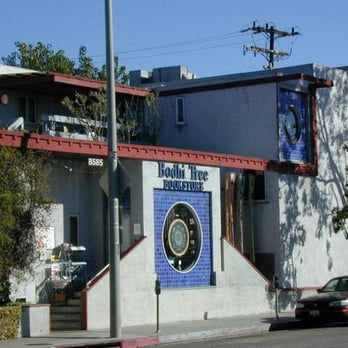
When I returned to Los Angeles, where I lived, I began a correspondence with Wilson that lasted over the years, and I would later visit Tetherdown again on several occasions, getting to know Colin, Joy, and their children, and building up a friendship. In the late 1980s and early nineties, Colin came to Los Angeles to give talks, and each time he came, we met. On one occasion I was house-sitting for one of the owners of the Bodhi Tree Bookstore, where I worked at the time-- it was the preeminent “metaphysical” bookshop west of the Rockies-- and I invited Colin and Joy to stay with me. During his stay he came to the shop and spent a huge sum, filling up boxes of books to be shipped back to Cornwall.
In 1996 I moved to London. Over the years I made the journey to Cornwall or met with Colin on his trips to London; on more than one occasion I interviewed him and wrote articles about his work and reviews of his books for some London newspapers.[iv] I always found him warm, generous, upbeat, and encouraging. One of our last meetings was at a conference in London in 2005, where he introduced me to the writer Graham Hancock. Afterward with Joy, and their son Damon and his family-- Colin enjoyed being a grandfather-- Colin took us to an Italian restaurant; he liked food and the wine flowed. I saw him again briefly in 2009 when he gave a talk in London, but as my young sons were with me and hadn’t the patience to sit still, I had to leave before saying good-bye.
It was sometime in 2011 that I heard that Colin had suffered a stroke following a difficult spinal operation. I knew he had had problems with blood pressure and the news of the stroke was not welcome. I had kept up our correspondence-- carried out by e-mail now-- and we had exchanged copies of our books; I even dedicated one to him.[v] But now it seemed clear that his health had taken a turn for the worse. At first the prognosis seemed hopeful but after a time it was apparent that damage had been done and that his condition would not improve.
I was in Holland when I heard the news that Colin had died. It was the weekend of December 6-7, 2013, and I was there giving a lecture. A text message from a mutual acquaintance came late at night telling me of his passing. His death at eighty-two following a severe illness was not unexpected but it nevertheless came as a shock. Like so many of his readers, I had somehow believed that he would go on forever. Now that constant flow of books had stopped.

I could not make the funeral, but a memorial service was held for Colin on October 14, 2014, at St. James’s Church in Piccadilly. Oddly enough it was the place I had last seen him, at the talk I had to leave abruptly a few years earlier. The poet William Blake-- whose poetry Wilson admired and had written about, featuring prominently in The Outsider and other books-- had been baptized there, and it was a place where many other “alternative” thinkers had lectured. Among others who had gathered to celebrate Colin’s life and to lament his passing, I was asked to speak, and in the five minutes allotted me, I tried to sum up the essence of his work. An impossible task, you might say, considering that he had written more than a hundred books about a dauntingly wide range of subjects. But Colin himself came to my aid.
In The Occult, the book that began my journey into Colin’s philosophy, he writes, “A single obsessional idea runs through all my work; the paradoxical nature of freedom.”[vi] In the five minutes I had, I tried to explain what Colin meant by this, attempting to condense in a few words what he had spent a lifetime investigating.

What is the “paradoxical nature of freedom?” It is the curious truth that when our freedom is threatened, we know exactly what it is and why it is important and are willing to risk our lives in order to protect or regain it. Its value is unquestioned, indubitable, and insistent. “It was,” Colin writes, speaking of freedom in the context of German tanks rolling into Warsaw or Soviet ones into Budapest, “something solid and definite that was being stolen, as a burglar might steal the silver.”[vii] But once the threat has vanished, somehow, imperceptibly, the meaning of our freedom dissipates, its value dissolves, becomes unreal and we fall into the trap of taking it for granted, as we do most of the things that matter to us in life, a human failing Colin saw as a version of original sin.
When we live comfortable, complacent existences, freedom, or any other our deepest values, becomes just a word, and because our grasp on our values grows limp, we waste our lives on trivialities, getting caught up in smaller immediate concerns and losing sight of the bigger picture, what Colin called the “bird’s eye view.” When this happens our idea of freedom becomes “blurred and indefinite” and “seems to shimmer like a mirage.”
“When I am confronted by a danger or crisis,” Colin writes, “I see it as a threat to freedom, and my freedom suddenly becomes positive and self-evident-- as enormous and obvious as a sunset.”[viii] Yet when the threat recedes, or the crisis abates, the sunset of freedom fades, and we slip back into a state of dullness and apathy, a lack of gratitude that we accept as “human nature.”

Colin “always accepted the fundamental reality of freedom” and had spent his life trying to uncover the inner mechanisms that enable us to grasp it. The vision, he believed, was “not an illusion or mirage,” as so much of the wisdom of the world, from Ecclesiastes to the absurdist playwright Samuel Beckett, one of Colin’s bête noires, would have us think. But if it is not an illusion-- if the vision of freedom, or meaning and purpose, is real-- then what happens? What goes wrong? Why does something we are willing to die for become, for many of us, a burden, a weight, something we want to escape from, as the title of a once popular book has it, and which we experience whenever we are bored and feel faced with the challenge of “killing time”?[ix]
“The trouble,” Colin saw, “is the narrowness of consciousness,” a shrinking of our awareness that reduces it to a mere reflection of the physical world and numbs our ability to appreciate the values and meanings that give our life purpose. This narrowness, he argued, “lulls us into a state of permanent drowsiness, like being half-anesthetized, so that we never attempt to stretch our powers to their limits.” And a consequence of this is that we never discover exactly what our limits are. We accept our dim, half-awake state as normal, as reality, and unless some crisis conveniently shakes us out of it, we live this way and die, having no idea what life, ours or anyone else’s, was about.
But in those moments when freedom and the values that give our life meaning are perceived as concrete, indisputable realties, we know this isn’t true, that our lives here are involved in something bigger than ourselves, that something important is at risk and that we are playing for very high stakes.
What causes this narrowing of our consciousness? And why is crisis able to widen it? The culprit is an evolutionary labour-saving device that Wilson called “the robot.” This is a kind of servant who does his job too well and has taken over control of our lives from its master-- that is, ourselves. The robot, let me point out, is not a villain. It is merely a helper, a necessary one, who, seeing that we lack the courage and commitment to really live our lives, has decided to live them for us. He has not, as we may think, usurped power from us. We have positively given it to him. But it is time to take it back, time to go beyond the robot and begin, in a paraphrase of T.S. Eliot, to “live the life we have lost in living.”[x]

This is the central theme, the “overwhelming question”-- another nod to Eliot-- that will be at the heart of this introductory overview of Colin Wilson’s life and work.[xi] What I will try to do here is to make clear some of the basic ideas and aims of Wilson’s philosophy in hopes that it will prompt readers unfamiliar with his work to seek out his books and read them for themselves.
For a dedicated reader like myself, one of the odd and frustrating things about Wilson is that many people know his name, and are familiar with some of his books on the occult, ancient mysteries, and crime, or one of his novels such as The Mind Parasites or his Spider World series, but are unfamiliar with the body of ideas that make up his philosophy and inform all of his work. His friend Robert Ardrey, author of the influential book The Territorial Imperative, once told Wilson that he wrote too much. Wilson agreed, but admitted that he couldn’t stop. “I write,” he once wrote, “as a dog with fleas scratches.”[xii] He told me at one point, “I had so much to say, I thought I wouldn’t be happy until I was seventy and had fifty books behind me.” Yet he was aware of the problems with this, especially in an age of increasing specialization. “The trouble with having so much to say,” he told me, “is that you write too much and cover too many subjects.” In addition to this there is the sheer pressure of work: “You’re also forced to write at a tremendous pace, just in order to make living.”[xiii]
I am not sorry that Wilson wrote so much, but I can appreciate that readers wanting to get an idea of what he is about might find it difficult to see their way in. They can see this book as a kind of Rough Guide to Wilson’s philosophy.
Mention of philosophy and abstruse terms such as “phenomenology” and “existentialism” may give readers unfamiliar with Wilson second thoughts, and suggest that they will find him too abstract and difficult. The opposite is true; Wilson writes some of the most readable prose in modern literature-- certainly in the “alternative” genre-- and, as one reviewer put it, “has a narrative style that can make the pursuit of any idea seem like exciting detective work.”[xiv]
It was this that gripped me when I first read The Occult forty years ago. As a good existentialist, Wilson is always concrete, not abstract. He uses examples from his own life and the lives of others in order to get his point across, and is adept at coining metaphors and analogies that give the reader a clear picture of what he means. He is also one of the great synthesizers, bringing together and linking up in new ways important insights and discoveries of other thinkers; following up the leads Wilson provides in books like The Outsider, The Occult, Mysteries, and many others, is like getting a liberal arts education.
Readers of Wilson will know this and need no inducement to go back and re-read his work; I leave it to those less familiar with him to enjoy an enlightening and educating experience.
So let us take a look now inside this Outsider and see if we can get an idea of the life and work of Colin Wilson.
[i] John Connell, Evening News May 26 1956.
[ii] I write about Crowley’s impact on me in my book Aleister Crowley: Magick, Rock and Roll and the Wickedest Man in the World(New York: Tarcher/Penguin, 2014)
[iii] Students of western philosophy will know that Husserl’s ideas are difficult, complex, and demanding, and that they are expressed in an abstract prose that makes Kant seem like summer reading. Wilson is aware of the vast literature around Husserl and phenomenology and it is not his, or my, aim to present a complete summary of it. Wilson reserves the right to take what is useful to him from Husserl’s large body of work and to, in effect, ignore the rest. This policy may seem scandalous to scholars but it is essential to the kind of effort Wilson and those who write about him are engaged in.
[iv] See, for example, “The Sage of Tetherdown: A Visit with Colin Wilson” Gnosis Winter 1996 pp.6-7; “Romanticism, Optimism, and Consciousness” Quest Summer 1996 pp. 19-23, 82-83; “Inside the Outsider” Fortean Times 188 pp. 40-43, and my review of Wilson’s second autobiography, Dreaming to Some Purpose, in the Independent on Sunday June 6, 2004 http://www.independent.co.uk/arts-entertainment/books/reviews/dreaming-to-some-purpose-by-colin-wilson-6168268.html An early article on Wilson, “Colin Wilson and Faculty X”, which originally appeared in Quest Summer 1995 can now be found in Revolutionaries of the Soul: Reflections on Magicians, Philosophers, and Occultists (Wheaton, Il: Quest Books, 2014) pp. 9-19.
[v] Gary Lachman The Caretakers of the Cosmos (Edinburgh, UK: Floris Boos, 2013).
[vi] Colin Wilson The Occult (New York: Random House, 1971) 9.
[vii] Ibid.
[viii] Ibid.
[ix] Erich Fromm Escape From Freedom (New York: Farrar and Rinehart, 1941).
[x] From Eliot’s “Choruses From the Rock.”
[xi] T.S. Eliot “Love Song of J. Alfred Prufrock.”
[xii] Colin Wilson Voyage to a Beginning: An Intellectual Autobiography (New York: Crown Publishers, 1969), 333.
[xiii] Gary Lachman “Inside the Outsider”
[xiv] Reviewer for The London Times, back cover of The Philosopher’s’ Stone (Los Angeles: Jeremy P. Tarcher, Inc., 1989).


It always interests me to read your writings about Colin Wilson, principally because it frequently mirrors my response to your own work. I was initially drawn to what appeared on the surface to be a growing body of work that digested and disseminated increasingly complex amounts of philosophy and esoteric thought in a form that was both entertaining and witty. Your work cuts to the heart of the matter, remains personal, is never condescending, and always informs and amuses. It was quickly addictive.
I soon found I wanted to read just about anything of yours I could find because the authorial voice was so present and free of pretension. Conversation rarely interests me, but reading your books are the equivalent…
I would never say that you write too much. The works seem to spiral out in an widening interconnectedness that is thorough and concise, and enjoyable!
Gary! You’re amazing!! On a quick break at my physiotherapy job right now but looking forward to really reading full post tonight. I’ve been reading through your first memoir again and it’s so generous of you to take us on your journeys. And the 12-year-old me is constantly incredulous that I can be in written correspondence with you. Thank you for all your hard work and for how you share it with us. You’re a gift.
I still have my copy of this wonderful book, and I'm glad to hear a new edition will be available to those who missed out on the earlier publication. I treasure your writing, and Colin Wilson's.
Too bad I'm not a reader, but I do glean golden nuggets by reading the comments under brilliant thinker's posts by highlighting words and having the text to speech read them to me.